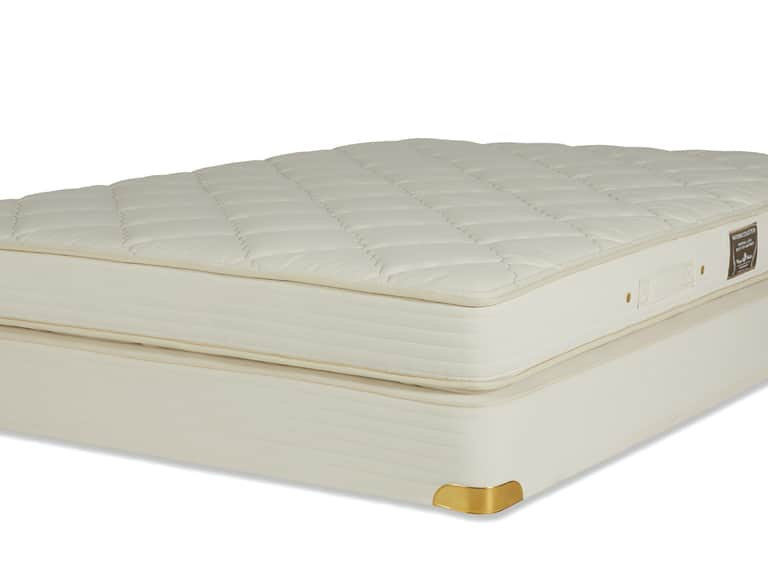
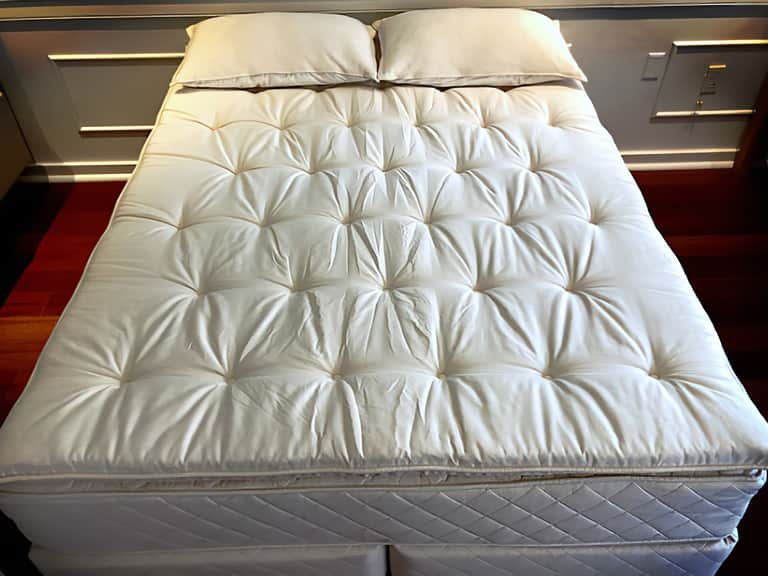
Bedding · Materials & construction
How Vispring’s Natural-Fiber Construction Balances Breathability and Support
A traditionally made mattress is less a single object than a small, hidden landscape: layers of fibers, springs, and fabric arranged to manage weight, warmth, and movement. Horsehair has a particular place in that landscape—not as a miracle material, but as a resilient, air-permeable filling whose qualities depend on how it is prepared and used.
Published November 17, 2026
There is something faintly theatrical about the word horsehair when it appears in a mattress description. It seems to arrive from another room in history, perhaps from a Victorian drawing room where a chair has been opened for repair and its dark stuffing exposed. The word is vivid; the material, in a finished bed, is not. It is concealed beneath ticking, quilted layers, and the ordinary choreography of sheets. Yet the qualities that made horsehair useful to upholsterers and mattress makers remain legible in the way a bed breathes, yields, and returns to shape.
Vispring offers a useful lens through which to consider that tradition. The company is associated with high-end, traditionally constructed mattresses, and natural fillings such as horsehair are part of the wider vocabulary of this kind of bedding. But a brand name alone cannot tell a reader what is inside every mattress, or how a particular model is assembled. Fillings, quantities, layering, and spring systems can differ across a range. The careful question is not simply whether a mattress is “natural,” but which materials it contains, where they sit in the construction, and what work each layer is meant to do.
That distinction matters because natural-fiber bedding is often discussed in broad, almost pastoral terms: breathable, sustainable, supportive. Those words may be meaningful, but they do not describe a complete sleeping experience. Comfort emerges from a system. The spring unit, upholstery layers, cover, bed base, room climate, and sleeper’s own preferences all contribute. Horsehair can play a part in balancing airflow and resilience; it cannot, by itself, promise a particular firmness, solve every temperature concern, or suit every body.
The structure inside the fiber
Horsehair used in upholstery and bedding is generally prized for its springy character. Its fibers are relatively coarse and resilient compared with soft, down-like fills. In traditional processing, hair may be cleaned and prepared, and some forms are curled or otherwise worked to create a loose, springing mass. The details depend on the source and method. Once placed within a mattress, the fiber can form an open, irregular structure, with spaces between strands rather than a tightly packed, uniform sheet.
Those spaces are part of the practical story. Air can move through a loose filling more readily than through a dense, compacted mass, although the degree of movement depends on the full construction. A mattress is not a ventilated box: fabric covers, quilting, adjacent layers, and the room itself all affect how air and moisture move. Still, an airy filling may help the interior exchange heat and water vapor rather than trapping everything at the surface.
Horsehair is also valued for its capacity to recover after compression. Sleep places a mattress under repeated pressure, night after night. A resilient fiber can spring back instead of remaining flattened immediately, contributing to the durability and loft of an upholstery layer. This is not the same as structural support. Support is a whole-bed outcome, shaped by the spring system or core, the arrangement and density of the comfort layers, and the sleeper’s body. A filling may help maintain a comfortable surface without being responsible for the mattress’s entire load-bearing role.
Think of a mattress as a well-run orchestra whose instruments are mostly behind a curtain. Springs may provide the principal response; fibers refine the sensation above them. Horsehair can add lively resistance and a less uniformly cushioned feel. Other materials, including wool and cotton, may contribute softness, moisture management, or a different kind of compression. In a layered construction, materials are not interchangeable simply because they come from nature. Each has its own texture, resilience, and behavior under pressure.
Breathability is a construction, not a slogan
People often describe a bed as “sleeping hot” or “sleeping cool,” as if temperature were an intrinsic property printed on the mattress label. In practice, the sensation develops through several exchanges: body heat moving into and through the bedding, moisture vapor leaving the skin, and air circulating around the sleeper. Room temperature, humidity, pajamas, sheets, mattress protectors, and personal physiology all have a part in the result.
Natural fibers can participate in this climate management. Wool, for example, can absorb water vapor and release it as surrounding conditions change. Horsehair’s open, springy arrangement may help air circulate within a mattress’s upholstery layers. But “breathable” should not be taken to mean that a mattress actively cools the body, nor does a breathable filling guarantee that every sleeper will feel cool. It describes a tendency of materials and construction, not a universal verdict on comfort.
For anyone researching a Vispring mattress, or another traditionally made model, the useful inquiry is specific. Ask which fillings are used in the exact model under consideration, whether horsehair is present and in which layer, and whether the maker publishes information about the fill’s preparation or origin. Ask how the upholstery is combined with the spring unit. A phrase such as “natural fillings” may refer to several materials, and the phrase alone does not reveal their proportions or placement.
It can also help to ask about the cover and the recommended bed base. A densely layered mattress on a solid, non-ventilating surface may behave differently from a comparable model placed on a base that permits airflow underneath. The environment around the bed is part of the environment inside it. In older homes, in humid climates, or in rooms that remain closed for long stretches, ventilation habits may matter as much as the name of a particular filling.
Support, resilience, and the feel of the surface
Support is sometimes treated as a synonym for firmness. The two are related but not identical. A mattress may feel firm at first contact and still fail to keep a sleeper comfortably aligned; another may feel welcomingly cushioned while providing adequate support beneath. A responsive fiber layer can alter the surface sensation, but the spring system and the thickness and arrangement of upholstery are central to the result.
Horsehair’s resilience can make it feel more buoyant or springy than a soft, deeply compressible filling. Some sleepers appreciate that liveliness; others prefer a more enveloping surface. Body weight, sleeping position, sensitivity to pressure, and movement preferences all affect perception. A person who sleeps on their side may notice pressure at the shoulder or hip differently from someone who sleeps on their back. Two people sharing a bed may also disagree, quite sincerely, about whether a mattress is soft, firm, or “just right.”
It is therefore wise to separate material claims from suitability claims. Horsehair may contribute to a mattress’s breathability and recovery, but those qualities do not establish that the mattress will suit a particular sleeper. If possible, test the specific model under realistic conditions and review the maker’s guidance on trial periods, comfort exchanges, and warranty terms. A material description is a starting point for comparison, not a substitute for experiencing the bed.
There is also a useful distinction between resilience and longevity. A resilient fiber may recover well under ordinary use, but a mattress’s service life depends on its entire construction, the quality of materials, the foundation, the frequency and distribution of use, and care. A traditional filling should not be romanticized into an assurance that it will last indefinitely. Like other materials, it can compress, shift, or require attention over time.
A short history of a practical material
Horsehair has a long association with upholstery and bedding. Before the spread of modern synthetic foams, makers relied on materials available through animal husbandry and textile trades: hair, wool, cotton, feathers, and plant fibers. In furniture, horsehair could be used as a resilient stuffing, often held in place by skilled handwork. In bedding, fillings were layered and contained within fabric casings, with the aim of making a surface that could cushion the body while enduring regular use.
The material’s reputation was built not only on its physical properties but also on craft. A filling does not arrange itself into a finished mattress. It must be selected, prepared, distributed, restrained, and combined with other components. The knowledge required to do that well is part of the object’s history, though it is not always visible once the mattress is complete. In restoration work, the opened seam may reveal as much about a bed’s construction as the finished surface does.
Modern mattresses offer a broad range of materials and manufacturing methods, and traditional fillings now occupy one corner of a much larger market. Their appeal may be practical, aesthetic, historical, or environmental. For some readers, a natural-fiber interior represents an alternative to foam-heavy construction; for others, it is a connection to the older language of upholstery. Neither motive should obscure the need for accurate specifications. “Traditional” is a description of lineage, not proof of performance in every circumstance.
What to ask when comparing natural-fiber mattresses
Product descriptions can compress a complicated object into a few elegant phrases. A little method helps restore the missing detail. When comparing Vispring or other natural-fiber mattresses, consider asking:
- Which fibers are present? Look for an itemized list rather than a general reference to natural fillings.
- Where are they placed? A fiber in the quilted top may affect surface feel differently from one layered deeper in the upholstery.
- How is support produced? Clarify the role of the spring unit or core, and how the upholstery layers interact with it.
- What does the maker mean by breathable? Ask for construction details, and avoid treating the word as a guarantee of a cool night.
- What care is recommended? Confirm whether the mattress should be rotated, turned, or kept in a particular orientation.
- What is known about sourcing? Ask whether the manufacturer provides information on fiber origin, processing, or animal-welfare standards.
These questions are especially useful because natural materials are not automatically interchangeable or automatically sustainable. Environmental impact depends on more than whether a fiber is plant- or animal-derived. Sourcing, processing, transport, durability, repairability, and end-of-life options all matter. A transparent answer may be more informative than a polished adjective.
Care begins with air and restraint
Natural-fiber mattress care is often less dramatic than people expect. The basic aim is to keep the bed dry, clean, and properly supported, while following the manufacturer’s instructions. Regularly airing the room and bedding can help reduce the accumulation of moisture. If the mattress has a removable, washable cover, its care label should govern cleaning; if it does not, the mattress itself should not be treated as though it were a washable household textile.
Vacuuming may be appropriate for surface dust when the maker recommends it, using a suitable attachment and gentle pressure. Liquids are more consequential. Saturating an upholstered mattress can push moisture into layers that dry slowly, potentially affecting fibers and encouraging odor or microbial growth. For a spill, blot promptly rather than rubbing, use as little moisture as possible, and consult the manufacturer’s instructions. Persistent stains, unusual odors, suspected dampness within the mattress, or damage to its interior are good reasons to seek specialist advice.
Turning and rotation should also be model-specific. Some mattresses are designed to be rotated head to foot; some may be turned; others have a designated top and bottom. The weight and construction of a large mattress can make handling awkward, and a mistaken turn may put the intended comfort layers in the wrong position. Check the care guide before moving it. A suitable support base, in good condition and used as specified, is equally important: a mattress cannot perform as intended if its foundation is sagging or incompatible.
A protector can help guard against spills and everyday wear, though it changes the textile layer above the mattress and may influence the feel or airflow of the sleep surface. Readers weighing that trade-off should look for clear information about fit, care, and construction rather than assume that any protector is neutral. A breathable protector, for instance, is designed to preserve more airflow than an impermeable barrier, but its performance still depends on its materials and use.
The questions that marketing cannot answer
There are limits to what a description can tell us about a mattress. It cannot fully predict how a sleeper will respond after several hours, how two partners will experience motion, or how a room’s humidity will shape the night. Nor can a reference to horsehair reveal the exact feel of a particular model without details about the rest of its construction. The honest approach is to treat material information as a map: useful for orientation, incomplete as a picture of the territory.
For some buyers, the attraction of natural-fiber bedding lies in the way it reconciles seemingly opposing aims. A mattress should cushion but not swallow; give way but return; retain enough warmth to feel comfortable while allowing heat and moisture to move. Horsehair is one old answer to that design problem. Its coiled, resilient character can support a lively upholstery layer, while its open structure may contribute to airflow. The results are shaped by the other materials around it and by the people who sleep there.
Vispring’s place in this conversation is best understood not as a claim that one brand or one filling suits everyone, but as an invitation to look closely at the construction. Read the specification for the particular model. Ask how its natural fibers are used, how the spring system works with them, and what care the maker expects. The answers can reveal whether the mattress’s materials align with a reader’s priorities—comfort, craft, climate, sourcing, or repairability.
Horsehair is not an enchanted ingredient. It is a material with a history, a recognizable set of physical characteristics, and practical limits. In a thoughtfully constructed mattress, those characteristics may help create a breathable, resilient surface. The larger achievement belongs to the whole design: fibers arranged with springs, covers, and upholstery in a balance that a sleeper can feel, even if the components themselves remain hidden. That balance is worth investigating slowly, with questions more useful than slogans.